
HMRC R&D Tax Claim Transparency and AI: Navigating the New Compliance Era

What if your next R&D tax credit submission was flagged for an enquiry by an algorithm before a human inspector even opened the file? It is a daunting prospect for any UK innovator. As we approach April 2026, the reality of hmrc r&d tax claim transparency ai means that automated risk profiling is now the first line of defence for the Treasury. You likely feel that the compliance landscape is becoming increasingly opaque. It's often difficult to distinguish between using AI as a simple tool and developing it as a core, claimable innovation.
We know that this shift feels like an added burden on your focus. This article ensures you understand how HMRC’s new transparency standards impact your claims, allowing you to secure vital money for reinvestment without the stress of an unexpected audit. We will explore the internal review triggers used by the tax office and provide a clear roadmap for documenting your 2026 projects with total confidence. Today’s adviser is tomorrow’s partner, and we are here to help your business thrive in this new digital era.
Key Takeaways
- Prepare for the 2026 shift towards AI-assisted compliance screening and understand how automated transparency will fundamentally change the HMRC review process.
- Explore how the landmark Elsbury ruling is forcing HMRC to disclose its internal AI processes, providing your business with a clearer roadmap for claim approval.
- Learn to navigate the "AI Dilemma" by identifying the critical distinction between a simple commercial advantage and a qualifying technological advance.
- Discover a rigorous two-step methodology to map every £1 of expenditure to specific uncertainties, ensuring your hmrc r&d tax claim transparency ai strategy remains robust under scrutiny.
- Understand the value of a partnership-led approach that transforms complex tax legislation into a seamless opportunity to secure vital money for reinvestment.
The 2026 Landscape: HMRC R&D Tax Claim Transparency and AI
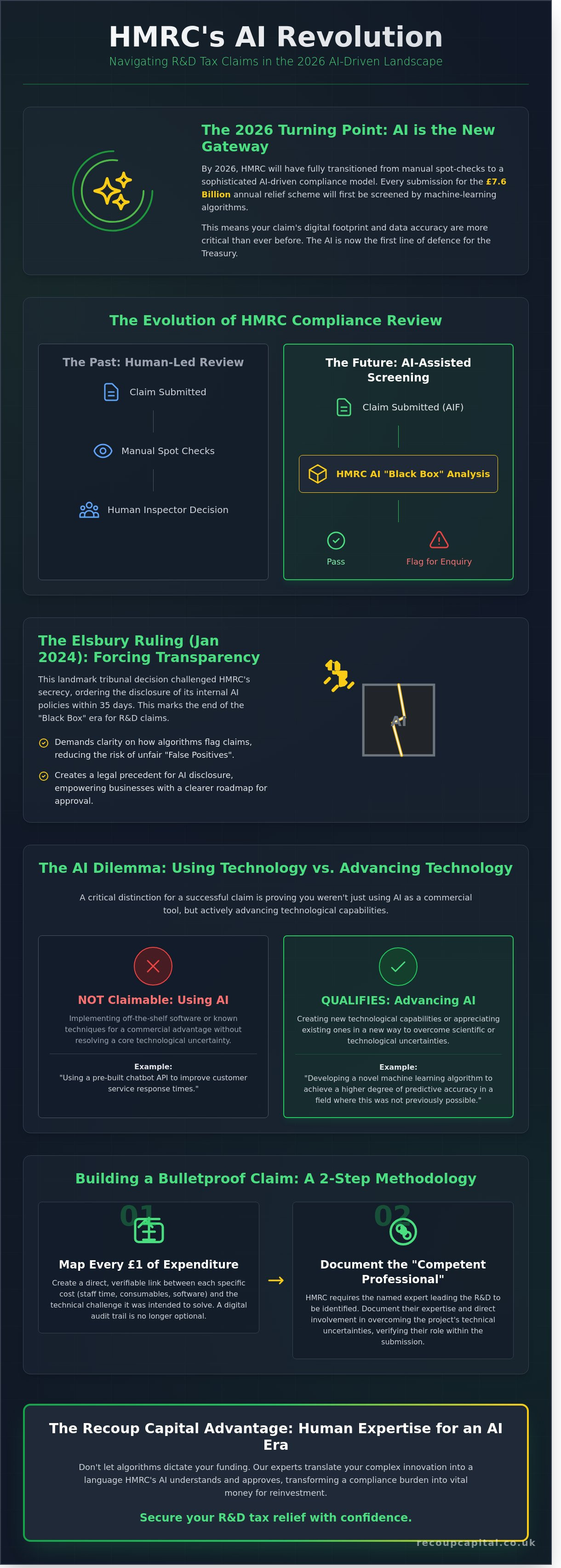
By 2026, transparency in the UK tax system has evolved from a simple reporting requirement into a rigorous, data-led mandate. HMRC has moved beyond manual spot checks, adopting a sophisticated tech stack that prioritises data-driven scrutiny over anecdotal evidence. The introduction of the Additional Information Form (AIF) in August 2023 was merely the foundation. Today, hmrc r&d tax claim transparency ai protocols serve as the primary gateway for the £7.6 billion in relief processed annually. This shift means that transparency now requires granular, real-time proof of technical uncertainty and financial expenditure.
HMRC now employs machine-learning algorithms to screen every submission against vast sectoral benchmarks. These systems identify "high-risk" claims by flagging anomalies in cost-to-staff ratios or technical descriptions that mirror generic templates. If your claim lacks specific, evidence-based documentation, it's likely to trigger an automated red flag. This transition from human-led reviews to AI-assisted screening has made the accuracy of your initial filing more critical than ever before. It's no longer enough to be innovative; you must be able to prove it through a digital audit trail that the R&D tax relief scheme now demands.
The Evolution of HMRC Compliance
The Merged R&D Scheme, which came into full effect following the April 2024 reforms, has centralised transparency requirements across the board. HMRC has used "Mandatory Random Inquiries" as a strategic tool to train its AI models, creating a high-fidelity map of what legitimate innovation looks like in every UK industry. Generalist accountants often struggle with these new automated hurdles because they lack the technical depth to satisfy an algorithm's need for specific engineering or scientific data. At Recoup Capital, we don't just file papers; we ensure the technical narrative aligns with the specific data points the hmrc r&d tax claim transparency ai systems are programmed to validate.
Why 2026 is a Turning Point for Claimants
2026 marks the deadline for businesses to move toward comprehensive digital record-keeping and real-time project tracking. HMRC now expects a clear link between the "competent professional" in your organisation and the technical uncertainties described in the claim. This professional must be named and their expertise verified within the submission. We help you identify these internal experts and document their contributions seamlessly. Our approach ensures that every claim is organised to meet these specific transparency benchmarks, transforming a complex compliance task into a reliable stream of money for reinvestment. We act as your expert partner, ensuring your innovation is recognised and rewarded without the stress of unexpected inquiries.
The Elsbury Ruling: Forcing Transparency on HMRC’s AI
In January 2024, the First-tier Tribunal delivered a landmark decision in Elsbury v The Information Commissioner. This case fundamentally shifted the landscape of R&D tax relief by challenging the secrecy of HMRC’s automated compliance systems. For years, HMRC operated behind a digital curtain, using undisclosed algorithms to flag claims for enquiry. The tribunal's order for HMRC to disclose its internal policies regarding the use of machine learning marks a pivotal moment for hmrc r&d tax claim transparency ai. It signals the end of the "Black Box" era, where businesses were left guessing why their legitimate innovation was suddenly under fire.
The "Black Box" refers to automated decision-making where the logic remains hidden from the taxpayer. When HMRC applies these automated filters, the risk of "False Positives" increases significantly. These are instances where the software incorrectly identifies a compliant claim as high-risk, often due to sector-specific expenditure patterns that the algorithm doesn't fully comprehend. For a business, this means an unexpected and often stressful enquiry triggered not by a human inspector's judgement, but by a line of code. It's a mechanical process that lacks the nuance required to evaluate complex scientific or technological uncertainties.
The Legal Precedent for AI Disclosure
The tribunal mandated a strict 35-day disclosure window for HMRC to provide clarity on its "Volume Compliance" strategy. This was a direct response to R&D practitioners who argued that HMRC’s refusal to share its AI policies created an unfair disadvantage for taxpayers. There's a profound public interest in understanding how algorithms judge innovation. With £7.6 billion in tax relief claimed in the 2021-22 period, the stakes are too high for the selection process to remain a secret. This ruling ensures that the logic governing hmrc r&d tax claim transparency ai is subject to public scrutiny, preventing arbitrary rejections based on flawed data sets.
What This Means for Your Next Claim
If HMRC uses automated tools to screen your submission, you must use precise data to defend it. It's no longer enough to provide a high-level narrative of your project. Your documentation must be "forensic-ready" from the first day of your R&D cycle. This involves maintaining contemporaneous records that align with the specific data points these algorithms are trained to verify. If you receive a rejection or an enquiry that feels generic, it's possible an AI error is at fault. You have the right to challenge these automated findings. We can help you navigate these technical hurdles during a free 15 minute consultation to ensure your claim is robust enough to satisfy both human and machine reviewers.
- Data-driven defence: Align your project records with HMRC's known risk markers.
- Challenging errors: Identify when an enquiry is based on a "False Positive" algorithm match.
- Proactive compliance: Treat your technical report as a legal document that must survive automated scrutiny.
The shift toward transparency is a win for honest innovators. It forces a level of accountability on the department, ensuring that the drive for compliance doesn't stifle the very growth the R&D tax credit scheme was designed to support. Your capital is too important to be lost to a software glitch.
The AI Dilemma: Using Technology vs. Advancing Technology
The single most common reason AI-related R&D claims fail HMRC scrutiny is the confusion between using a tool and creating one. Many businesses mistake a commercial advantage for a technological advance. If your company uses a third-party API to automate customer service, you've improved your business efficiency, but you haven't advanced the field of computer science. HMRC R&D tax claim transparency ai standards now require clear evidence that you've moved the "baseline" of technology forward. Simply being the first in your specific sector to use a certain software doesn't count as innovation in the eyes of the taxman.
Integrating an existing Large Language Model (LLM) like GPT-4 or Claude is rarely enough to qualify for relief. These are powerful tools, yet plugging them into your workflow is considered a routine configuration. To claim successfully, you must identify "Technological Uncertainty." This exists when your technical team faces a problem that a competent professional cannot solve using existing knowledge or common practice. If your developers spent weeks fine-tuning a model to handle proprietary data structures where standard libraries failed, you might have a claim. You must document the "trial and error" process, showing that the solution wasn't obvious from the start.
Framing the Technological Advance
To secure your claim, you need to go "under the hood." HMRC wants to see modifications to algorithms, improvements in data processing speeds, or new ways to reduce the computational "cost" of a model. Improved efficiency is a commercial benefit; a reduction in the memory overhead of a specific neural network architecture is a technical advance. You must prove that the technical challenges were non-trivial and required a systematic investigation.
AI in Non-Tech Sectors: Construction and Engineering
Innovation isn't restricted to software houses. In the UK construction sector, firms are increasingly using AI for predictive maintenance in complex building projects. A recent project involved developing an AI system to predict structural fatigue in high-rise builds using real-time sensor data. Standard AI tools failed because they couldn't filter out the "noise" created by heavy machinery on-site, leading to a 40% error rate in early testing.
- Engineers had to develop a bespoke filtering algorithm to clean the data before it reached the neural network.
- The project involved overcoming the uncertainty of how different building materials affect sensor signal latency.
- Standard libraries were unable to process the sheer volume of data in real-time without crashing the local server.
Recoup Capital helps construction firms extract R&D from applied AI by identifying these hidden technical hurdles. We don't just look at the finished product; we look at the failures and iterations that happened during development. This level of hmrc r&d tax claim transparency ai reporting ensures that your claim is robust and defensible. We turn your technical struggles into money for reinvestment, helping your business thrive in a competitive market.
Practical Compliance: Building a Robust Claim in 2026
By 2026, the era of "estimate and hope" has vanished. HMRC's digital-first approach means your claim must be bulletproof before it ever reaches an inspector's desk. Compliance is no longer a post-project chore; it's a real-time requirement for any business seeking money for reinvestment. To secure your claim, you need a structured, evidence-led process that withstands both algorithmic and human scrutiny.
- Step 1: Conduct a technical audit first. Never start with the numbers. Identify the technical uncertainties before looking at the payroll. If the science doesn't justify the claim, the financial data is irrelevant.
- Step 2: Map every pound. Every £1 of expenditure must link directly to a specific technical uncertainty. HMRC now expects granular detail that connects staff hours or subcontractor costs to specific roadblocks.
- Step 3: Document "failed" experiments. Success isn't a requirement for R&D tax credits, but proof of effort is. Documenting trials that didn't work provides powerful evidence of R&D intensity and technical difficulty.
- Step 4: Write for the machine. The hmrc r&d tax claim transparency ai systems scan for specific markers of eligibility. Your narrative must be clear, structured, and free of marketing fluff.
- Step 5: Review CT600 integration. Your tax return and the Mandatory Additional Information Form (AIF) must be perfectly aligned. Any discrepancy between these documents is an immediate red flag for HMRC's risk-profiling software.
The Importance of the Technical Narrative
Avoid the "Sales Pitch" trap. HMRC inspectors aren't impressed by your market share or your turnover; they want to see technical "gaps" and how you tried to bridge them. Use precise industry terminology to signal expertise. If you're developing software, talk about latency constraints or API integration challenges rather than just "making it faster." Our chartered tax accountants work alongside your technical leads to ensure the narrative meets the strict definitions found in the CIRD manual without losing the essence of your innovation.
Mitigating the Risk of an HMRC Inquiry
HMRC's AI screening tools look for anomalies that suggest a lack of care. Claims that feature "round numbers"-such as exactly £20,000 for materials-or those claiming 100% of every director's time are frequently flagged for manual review. A Pre-Submission Review by an R&D tax credit specialist acts as a vital safety net. It identifies these triggers before they reach the tax office. If you are already facing questions, knowing how to prepare for an HMRC R&D inquiry can significantly reduce the stress and financial risk involved.
Don't leave your claim to chance. We help you transform complex technical data into a robust, compliant submission that secures the funding your business deserves. Book your free 15-minute consultation to verify your claim's strength.
The Recoup Capital Advantage: Human Expertise for an AI Era
As HMRC adopts more automated systems to monitor submissions, the necessity for human oversight has reached a critical point. Our approach prioritises hmrc r&d tax claim transparency ai standards by combining technical precision with real-world sector experience. We don't just process paperwork; we build robust, compliant narratives that stand up to rigorous scrutiny. This ensures your business remains protected while you access the funding you're entitled to.
Our success-based fee structure ensures our interests are perfectly aligned with your company's long-term compliance. Because we only succeed when your claim is successful, we're incentivised to be meticulous rather than aggressive. This results-driven consultancy model replaces the traditional sales pitch with tangible value, providing the clarity HMRC expects while maximising the reinvestment capital available to you. We operate as "Today’s adviser, tomorrow’s partner," guiding you through the 2023 and 2024 legislative shifts with confidence.
End-to-End Claim Management
Our specialists look far beyond the obvious. We identify "hidden" innovation within your daily operations that internal teams often overlook, such as bespoke software patches or unique engineering workarounds. Our process includes forensic surveying for both R&D and capital allowances, ensuring every eligible pound is accounted for accurately. From the initial technical assessment to direct HMRC liaison, we manage the entire lifecycle of the claim. This seamless transition allows your team to focus on core operations while we handle the complex tax geometry.
Start Your Innovation Journey Today
UK limited companies have a unique opportunity to fuel their growth through strategic tax relief. This isn't merely a refund; it's vital money for reinvestment that can fund new hires, equipment, or further research. We've facilitated millions in tax relief for businesses across the UK by transforming complex government processes into approachable opportunities. Our team provides a protective layer between your business and the complexities of tax law, acting as the expert friend who understands your bottom line.
Ready to see how much your innovation is worth? A quick conversation can reveal significant opportunities for your business growth. Book your FREE 15-minute R&D consultation today to speak with a specialist and start your journey toward financial recovery.
Future-Proof Your Innovation Strategy for 2026
The 2026 landscape for R&D tax credits demands a higher standard of evidence than ever before. Following the landmark Elsbury ruling, the focus on hmrc r&d tax claim transparency ai has shifted the burden of proof back onto the claimant. You can't rely on generic automated descriptions to justify complex technical breakthroughs in construction, engineering, or software development. HMRC now requires a precise distinction between simply using technology and actually advancing it. This means your technical narrative must be robust, human-led, and meticulously documented to withstand scrutiny.
Navigating these regulatory shifts doesn't have to be a burden. Our team of chartered tax accountants and technical specialists provides the professional authority needed to secure your money for reinvestment. We operate on a success-based fee structure; we only win when you do. With a proven track record across the UK's core industrial sectors, we transform intimidating tax legislation into a seamless opportunity for your business to thrive. It's time to move beyond simple paperwork and build a partnership that protects your future claims.
Ready to secure your capital? Book your FREE 15-minute consultation with our R&D specialists today and let's ensure your innovation gets the reward it deserves.
Frequently Asked Questions
Is HMRC using AI to automatically reject R&D tax credit claims?
HMRC doesn't use AI to automatically reject claims, but it does use automated risk-profiling systems to flag suspicious applications for manual inquiry. Since April 2023, the department has significantly increased its compliance team to over 500 staff members. These specialists review flagged claims to ensure they meet the Mandatory Random Enquiry Programme standards. Automated checks focus on identifying inconsistencies in hmrc r&d tax claim transparency ai data points before a human caseworker makes the final decision.
What does "transparency" mean for my business when filing an R&D claim?
Transparency means providing full visibility into your project's technical uncertainties and qualifying costs via the Additional Information Form (AIF) introduced on 8 August 2023. You must now name the senior officer responsible for the claim and identify any external agents involved. This level of hmrc r&d tax claim transparency ai ensures that every pound of expenditure is linked to a specific advance in science or technology. It removes the "black box" approach to filing and builds trust with the tax office.
Can I still claim R&D tax credits if I am using third-party AI tools like ChatGPT?
You can still claim if your project involves overcoming technical challenges that go beyond the standard implementation of third-party AI tools. Simply using ChatGPT to write code or generate content doesn't qualify as R&D. However, if your team is developing proprietary wrappers, fine-tuning models with unique datasets, or solving latency issues that aren't addressed in public documentation, those activities often meet the criteria. The focus remains on the specific technological advance your business is creating.
What are the main challenges of claiming R&D for AI projects in 2026?
The primary challenge in 2026 is the rapidly shifting "baseline" of publicly available knowledge. As AI capabilities become commoditised, HMRC expects businesses to prove their work exceeds the standard knowledge of a competent professional in the field. You'll need to demonstrate that your solution wasn't "readily deducible" at the time of development. Documentation must be more granular than ever; it should show the specific iterations and failures that occurred during the development of your machine learning models.
How can I prove that my AI project constitutes a technological advance?
You prove a technological advance by documenting the gap between existing industry capabilities and your final product. Under the 2004 BIS guidelines, which still underpin current legislation, you must show that the "state of the art" was insufficient for your needs. This involves providing technical logs, version control records, and meeting notes that highlight the specific uncertainties you faced. Evidence of failed experiments is particularly valuable, as it demonstrates that the solution wasn't obvious to an expert.
What happens if HMRC’s AI selects my claim for an inquiry?
If your claim is selected for an inquiry, you'll receive a formal letter from HMRC requesting detailed evidence for specific expenditure items. You typically have 30 days to provide a comprehensive response. This process is part of HMRC's "compliance by design" strategy, which saw a 50% increase in inquiries between 2022 and 2024. Don't panic; it's an opportunity to clarify your technical achievements. Having a specialist partner ensures your evidence is presented in the precise format caseworkers expect.
Do I need a specialist R&D consultant if I have a general accountant?
While a general accountant is vital for your annual filings, a specialist R&D consultant brings the technical depth required to navigate complex software and AI claims. Generalists often lack the engineering or data science background to identify every qualifying activity. A specialist acts as your protective guide, ensuring your technical narrative aligns with the latest HMRC manuals. This partnership reduces the risk of errors while maximising the money available for reinvestment into your next innovation.
How much does it cost to use a specialist for an R&D tax claim?
Most R&D specialists operate on a contingency basis, meaning they only charge a percentage of the successful tax credit or refund they secure for you. This "no win, no fee" model ensures there's no upfront cost or financial risk to your business. Typical market rates vary depending on the complexity of the claim and the level of support required. This structure aligns the consultant's interests with yours; it focuses entirely on a successful, compliant outcome that helps your business thrive.